


By: Figo Mansaray | Staff Writer
Monrovia, Liberia |November 26, 2026|The West African Tax Administration Forum (WATAF) and the Economic Community of West African States (ECOWAS) have agreed on four priority areas for joint action in 2027, aimed at strengthening tax administration and improving domestic revenue mobilization across West Africa.
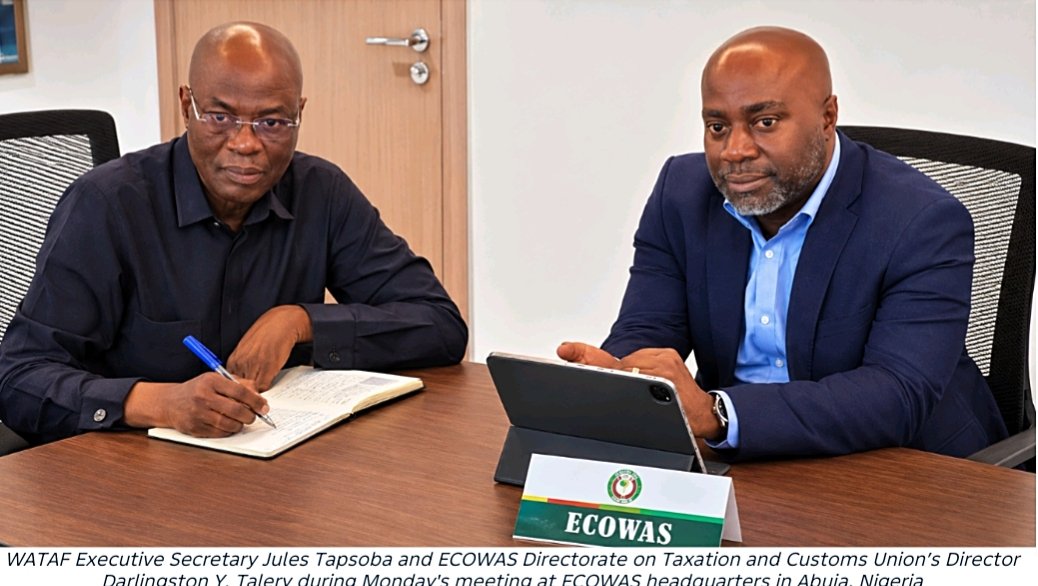
The agreement was reached during the WATAF–ECOWAS Quarterly Coordination Meeting held on Monday, November 23, 2026, at the ECOWAS Commission’s New Headquarters in Abuja, Nigeria.
The meeting brought together the WATAF Secretariat, headed by Executive Secretary Jules Tapsoba, and the ECOWAS Directorate on Taxation and Customs Union, led by Director Darlingston Y. Talery.
Both institutions reviewed their performance during the third quarter of 2026 and discussed ongoing activities, plans for the remainder of the year, and proposed joint programs for 2027.
The discussions focused on improving coordination, strengthening national tax administrations, and ensuring that regional tax initiatives respond to the actual needs of member countries.
Speaking during the meeting, ECOWAS Director of Taxation and Customs Union, Darlingston Y. Talery, emphasized the need for stronger cooperation that produces practical results in tax administration and revenue collection.
“We don’t just need to plan, but to implement what we plan, plan what the people need,” Talery stated, stressing that joint programs should avoid duplication and address the specific needs of beneficiary countries.
He acknowledged that progress had been made in regional tax cooperation but noted that more work was required to strengthen tax systems and improve revenue mobilization.
“We have made progress, but we still need to do more; we still have a lot to do in the region,” he added.
Talery also called for greater engagement with national tax administrations to identify their institutional weaknesses, capacity gaps, and reform priorities before developing regional interventions.
On domestic revenue mobilization, he disclosed that West African countries had reached approximately 65 percent against a regional benchmark of 70 percent for domestic revenue contribution to national budgets.
He described the progress as encouraging but emphasized the need for additional capacity development to close the remaining five-percentage-point gap.
The ECOWAS official further highlighted the importance of maintaining reliable databases on tax expenditures, trade policies, and revenue statistics to support informed decisions and improve tax administration.
“It’s a lot we have to do, but it is doable,” he affirmed.
Meanwhile, WATAF Executive Secretary Jules Tapsoba commended ECOWAS for hosting the coordination meeting and acknowledged the productive working relationship between the two regional institutions.
Tapsoba welcomed the continued technical cooperation, noting that collaboration would allow both organizations to combine their expertise, coordinate activities, and provide stronger support to national tax administrations across West Africa.
Following discussions on their respective work programs for 2027, the two institutions identified four areas for joint action: Value Added Tax (VAT) and tax expenditure initiatives, joint engagement with ECOWAS parliamentarians, research on carbon taxation, and beneficial ownership.
The four priorities are expected to guide their cooperation in the coming year, with the broader objective of strengthening tax systems, improving institutional capacity, and supporting domestic revenue mobilization across the region.
The meeting concluded with both institutions reaffirming their commitment to translating regional plans into practical programs that address the needs of West African tax administrations.
The West African Tax Administration Forum (WATAF) is a regional organization that brings together tax administrations across West Africa to strengthen domestic resource mobilization through cooperation, capacity development, and knowledge sharing.
The organization also supports regional dialogue on tax policies and the modernization and harmonization of tax systems in line with regional and international standards.
