


By: Ben T.C. Brooks | River Gee Correspondent
River Gee County | April 6, 2026 | The Ministry of Agriculture in River Gee County has successfully concluded Phase II of its Farmer Field School Training of Trainers, marking another significant step toward strengthening agricultural capacity at the grassroots level.
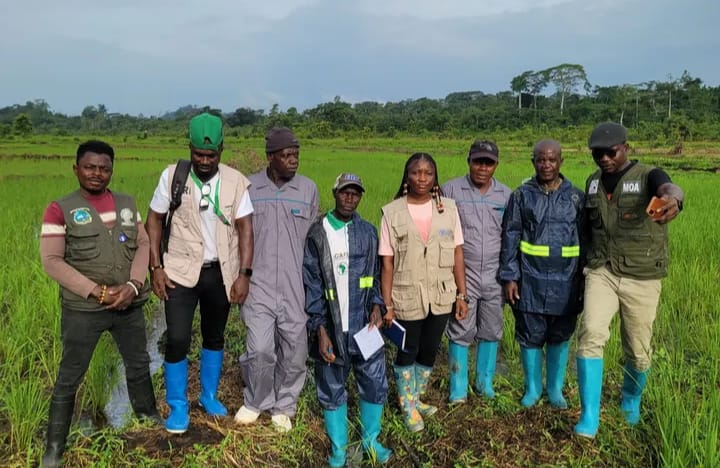
The intensive weeklong training, which ended on Sunday, April 4, in Fish-Town, brought together twelve lead farmers, to include ten males and two females, under the Smallholder Agriculture Development for Food and Nutrition Security – SADFONS, project.
SADFONS is a flagship agricultural initiative in Liberia aimed at improving food security, reducing rural poverty, and increasing productivity among smallholder farmers.
Supported by international partners, including the Global Agriculture and Food Security Program – GAFSP, and the African Development Bank – AfDB, the project targets more than 11,700 farming households across the country.
Its interventions focus on key value chains such as rice, cassava, and vegetable production.
The Farmer Field School training was designed to provide participants with hands-on experience and modern agricultural techniques.
As part of a Training of Trainers model, the program equips selected farmers with the knowledge and leadership skills needed to serve as extension resource persons within their respective communities.
Facilitating the sessions were SADFONS Project Coordinator Dennis Weagbe, Agronomist Menson Roland Kwanwah, along with county and district agriculture officers.
The curriculum covered a range of improved farming practices, including effective planting methods, soil management, and crop substitution strategies aimed at boosting yields and resilience.
Speaking on behalf of the participants during the closing ceremony, lead farmer Beatrice Wesseh expressed deep appreciation to the Ministry of Agriculture, particularly County Agriculture Coordinator Jasper Sheriff Tweh, for the continued support and investment in local farmers.
“Knowledge is power,” Wesseh stated, emphasizing that the training represents a crucial step toward building a more resilient and productive agricultural sector.
She also called for sustained investment in farmer capacity-building initiatives, noting that such programs have the potential to significantly increase agricultural output not only in River Gee County but across Liberia.
Participants are now expected to return to their communities and replicate the training by sharing the skills and knowledge they have acquired.
The peer-to-peer approach is expected to accelerate the adoption of improved farming techniques and strengthen local food systems.
In remarks delivered on behalf of the Ministry, County Agriculture Officer Jasper Sheriff Tweh reaffirmed the government’s commitment to working closely with farmers to enhance national food production.
He also commended district agriculture officers for their dedication and effective facilitation of the training.
With the successful completion of Phase II, the newly trained farmers are well-positioned to serve as catalysts for change, expanding access to modern agricultural practices and supporting sustainable development at the community level.
The initiative highlights Liberia’s broader efforts to revitalize its agricultural sector by empowering local farmers as key drivers of economic growth, food security, and long-term sustainability.

