


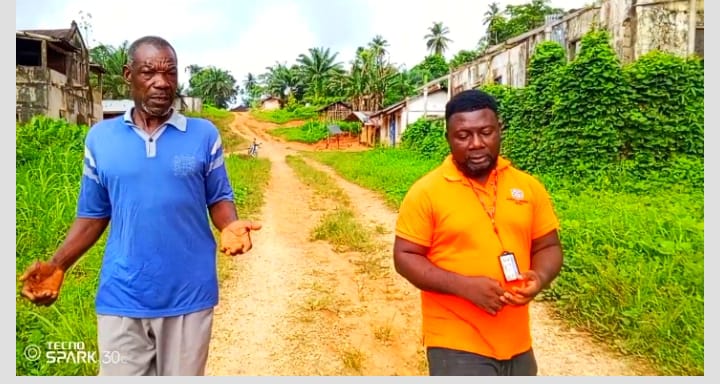
By: Ben TC Brooks |River Gee Correspondent
River Gee County | Feb. 26, 2026 | Along the banks of the Cavalla River lies Nyaaken, a historic town in southeastern Liberia that once stood at the center of trade, diplomacy, and national identity; facing mounting development challenges that residents say threaten to erase its legacy.
Formerly part of Maryland County, Nyaaken has long served as a key gateway between Liberia and neighboring Ivory Coast.
Its strategic riverfront location made it a natural crossing point and commercial hub for communities on both sides of the international border.
Today, Nyaaken remains approximately 50 kilometers from Fish-Town, the county capital of River Gee.
Nyaaken is widely recognized for hosting Liberia’s official international border post. In 1927, a prominent stone monument was erected in the town honoring former President Charles D. B. King and Vice President Allen N. Yancy.
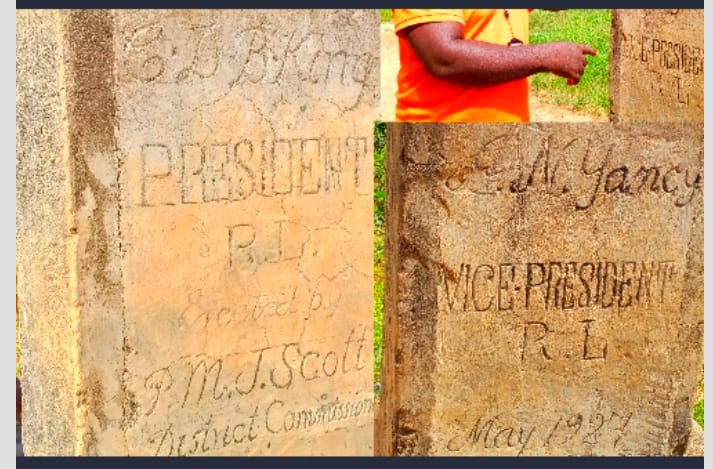
The monument formally affirmed Liberia’s territorial limits during a critical period of regional boundary demarcation.
Positioned directly across from Ivorian territory along the Cavalla River, the marker stands as a lasting symbol of Liberia’s sovereignty and diplomatic history.
Long before the border stone was installed, Nyaaken functioned as a thriving trading post, as historical accounts also link the town to 19th Century commerce along the Cavalla River corridor, including trade networks that were at times associated with the transatlantic slave trade.
However, Nyaaken’s history is not solely defined by commerce and diplomacy. In the early 20th century, the area became associated with forced labor practices under local administrative authorities.
Oral histories recount that residents from surrounding towns and villages were compelled to construct the road linking Nyaaken to the main government highway using only manual labor.
Selected individuals reportedly worked for weeks at a time without compensation and under harsh conditions.
Pre-trial detainees were also allegedly forced to work on a district commissioner’s farm. These practices occurred during a period when hut taxes already imposed heavy burdens on rural communities, raising serious concerns about civil and human rights abuses.
Despite its painful chapters, elders recall a time when Nyaaken was vibrant and orderly.
Elder Josephus Diggs explained that many current residents are descendants of individuals brought to the area through forced labor.
“Most of us were born and raised here because our parents were brought in under forced labor,” he said. “When I came of age, Nyaaken was well developed and movement was restricted. The entire area had electricity and active businesses.”
He also reflected on the town’s once-strong education system, noting that the St. Mary’s Catholic School and Nyaaken Community School were central institutions.
According to him, what later became Webbo High School originated in Nyaaken before relocating to Kronowroken in 1978 after storm damage destroyed the NCS facility.
Ma Marry Free, another longtime resident, described a disciplined and closely knit community.
“After school, you went straight home. You couldn’t just enter someone’s yard without permission,” she recalled. “Today, things are very different.”
She added that Liberia’s 19th President, William V. S. Tubman, visited and stayed in Nyaaken on several occasions, underscoring the town’s former national significance.
Residents also remember vibrant trade activity involving Togolese merchants, Congolese settlers, and members of the Grebo ethnic group from Maryland’s Harper region.
While no longer marked by forced labor or colonial-style administration, residents say the town now faces a different struggle of neglect by national government.
The community grapples with limited access to safe drinking water, deteriorating public infrastructure, poor road conditions requiring urgent rehabilitation, and inadequate access to quality education.
Several abandoned and broken structures, once owned by prominent Liberian families, stand as reminders of the town’s past prominence.
Residents referenced connections to families of notable figures, including businessman and Liberian politician Alexander B. Cummings and families of former Senator Edmond B. Gibson Sr. who died in April 2004 and was buried at his abandoned resident, located left entrance point to Nyaaken Community.
Most residents now depend on subsistence farming, small-scale trade, and motorized or propeller-driven boats that serve as the primary means of transportation across the river between Liberia and Ivory Coast.
However, community members are urging national authorities to prioritize development in Nyaaken, arguing that its historical significance warrants greater government investment and modernization.
Now from its origins as a 19th-century trading hub to the erection of the 1927 bordering monument, and from memories of forced labor to present-day economic hardship, Nyaaken remains a place where Liberia’s past and future converge.
Meanwhile, many residents, suggest preserving the town’s history to go hand in hand with building a more sustainable and dignified future for Liberia.

