


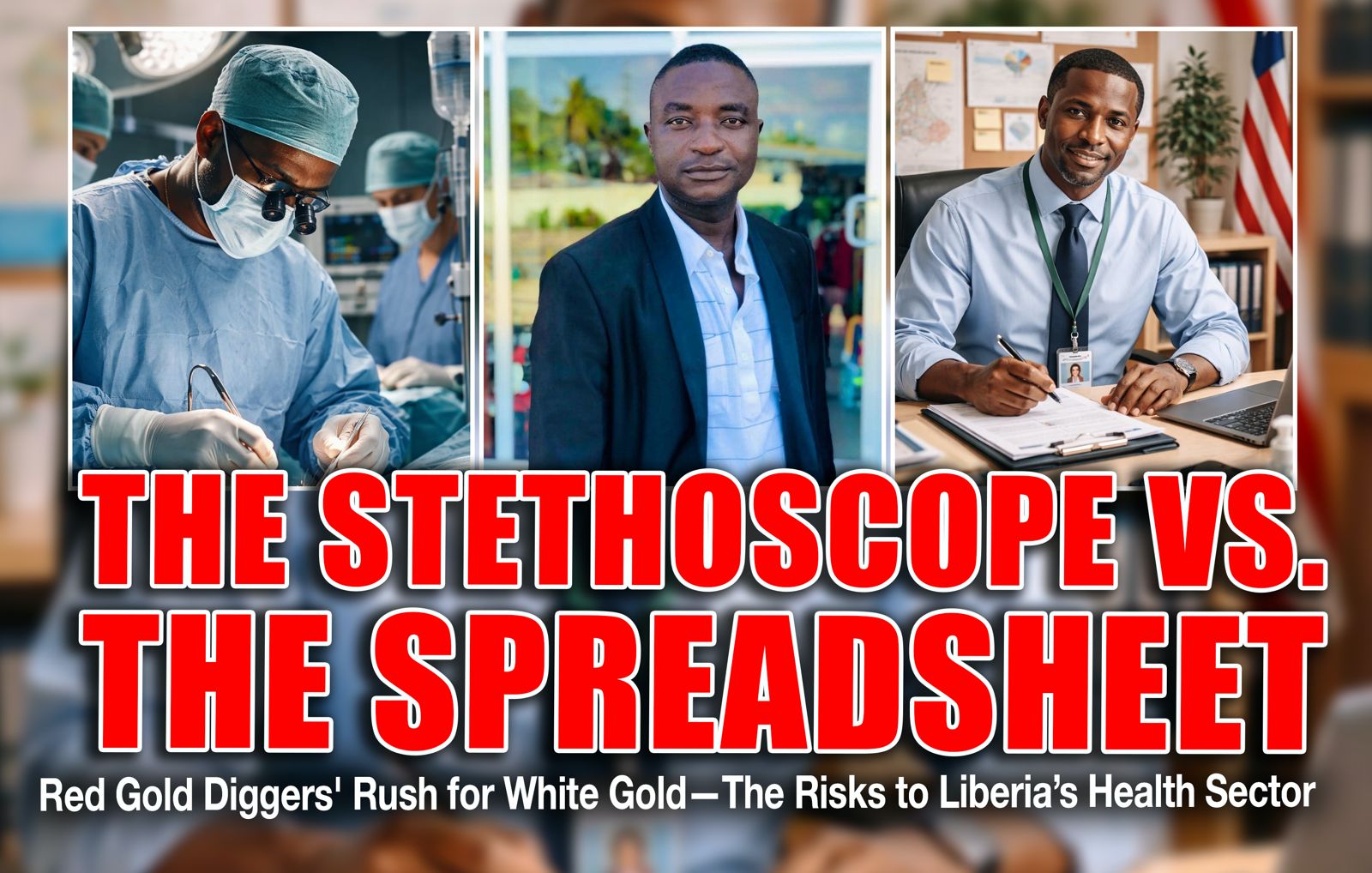
The Liberian health sector is currently embroiled in a silent but high-stakes “gold rush.” On one side lies the Red Gold of clinical medicine—the vital, life-saving work at the bedside. On the other lies the White Gold of public health—the domain of data, international funding, and national policy.
A dangerous trend has emerged: clinicians are increasingly abandoning their stethoscopes in pursuit of prestigious White Gold administrative roles, often without the necessary transition in scientific training. This is not merely a professional shift; it is a growing crisis of credibility that threatens the safety and wellbeing of the Liberian people as public health is proactive and medicine is reactive.
The Myth of a Natural Transition
There is a prevailing misconception among many “Red Gold Diggers” that a clinical degree serves as a master key to public health leadership. However, the skill sets are fundamentally different. A clinician is trained to save individual lives, while a public health scientist is trained to protect entire populations. Even Dr. Joseph Nagbe Togba, widely regarded as a pioneer of modern public health in Liberia, recognized this gap and sought specialized training at Harvard University to bridge the divide between clinical practice and population-based science.
When Politics Overrides Science
The consequences of this professional misalignment are increasingly visible, particularly in the institutional tensions between the Ministry of Health (MOH) and the National Public Health Institute of Liberia (NPHIL). Allegations of outbreak declarations driven by financial incentives rather than scientific thresholds, along with judicial overreach into technical public health decisions, suggest that “White Gold” is becoming dangerously politicized. This politicization carries serious consequences, eroding public trust and weakening evidence-based decision-making.
For instance, because many of the initial responders to the Ebola outbreak were not public health specialists, their approaches often triggered panic among victims and their relatives. This fueled fear and suspicion, with some communities believing the disease was a government scheme to attract international funding. As a result, caretakers sometimes fled with infected patients to unknown locations, accelerating the spread of the virus and increasing fatalities. The media reported widespread denial and mistrust among communities in Monrovia, particularly in West Point.
A Legacy of Data Failures
Liberia has already experienced the cost of prioritizing clinical hierarchy over granular data analysis:HIV: While the national prevalence of 1.1% appears low, disaggregated data reveals a hidden crisis, with nearly 50% of cases concentrated in Montserrado County.
Traffic Safety: Aggregate statistics obscure the reality that although accidents are more frequent in urban areas, they are significantly more fatal—up to 85%—in rural counties such as Bong.
Policy Reactionism:
The recent ban on Misoprostol risks fueling a black market, as it appears to be driven more by anecdotal reports than by structured pharmacovigilance data.
Structural Misalignment and Data Integrity
The misplacement of clinicians into administrative public health roles undermines Liberia’s capacity to generate, interpret, and act on high-quality health data. Liberia’s health system is defined by two distinct professional spheres: Red Gold: Clinical practice. White Gold: Public health, data science, and policy.
The current identity crisis stems from clinicians migrating toward White Gold roles, often attracted by donor funding and policymaking influence, without adequate training in epidemiology, biostatistics, or health economics. This has contributed to the misinterpretation and miscommunication of sensitive public health data, such as HIV prevalence reports in communities like Duport Road released in November 2025.
Case Studies in Mismanagement
Several examples highlight the risks of this imbalance: Epidemiological Blind Spots: National HIV prevalence (1.1%) masks disproportionately high prevalence rates, such as 37.9% among men who have sex with men (MSM). Lethality vs. Volume: Traffic data reported by the Liberia National Police lacks the granularity needed to explain why rural accidents result in significantly higher fatality rates than urban incidents.
Regulatory Reactionism: The regulation of Misoprostol mirrors the “Tramadol Trap,” where policy decisions are made without comprehensive impact assessments, inadvertently empowering unregulated markets.
Institutional Integrity and the MOH–NPHIL Rift
The Monkeypox reporting discrepancies serve as a critical example of how White Gold can be weaponized for administrative gain. When outbreak declarations conflict with scientific data produced by NPHIL, the foundation of public trust begins to erode. This institutional friction is worsened when clinical administrators prioritize political narratives over epidemiological evidence, particularly when financial incentives are involved.
A Mandate for Specialized Leadership
Liberia’s health sector is facing a clear crisis of credibility, driven by the mass migration of clinicians into public health administrative roles. An estimated 90% of county health officials are clinicians, many of whom lack specialized training in population health science and data analytics.
To build a resilient and responsive health system, Liberia must adopt a model of rational deployment: Clinicians should be prioritized at the bedside to address the critical doctor-to-patient ratio. Public health leadership roles should be reserved for trained epidemiologists, biostatisticians, and health economists.
The Duport Road HIV reporting incident illustrates the real-world consequences of this misalignment, where poorly contextualized data led to stigma, fear, and social disruption.
Conclusion
When Red Gold Diggers abandon their stethoscopes for White Gold administrative roles without proper training, the consequences are far-reaching. Not only does it weaken data integrity and policy effectiveness, it also exacerbates the already critical shortage of clinicians at the bedside.
Liberia’s health system cannot afford this imbalance. The distinction between saving individual lives and safeguarding population health must be respected, strengthened, and institutionalized. Only then can the country build a health system grounded in both clinical excellence and scientific integrity. In short, strengthening public health could save far more lives at a lower cost, especially in resource constrained country like Liberia.
By Bushuben A. Kanneh/Epidemiologist and Faculty Lecturer
Email: bushubenkanneh@gmail.com/Phone: (+231) 0886875271

